I've returned from Joplin. Lots to tell about the tornado and the destruction it left behind. I will save that for another day. While I was there, Mom asked me to take a look at her hollyhock in the back yard, which has some problems. For one thing, its lower leaves are all eaten out.

I found the culprit fairly quickly - caterpillars. They are very small and well camouflaged, so Mom had missed seeing them without her glasses. Here are some pictures. It's sort of like Where's Waldo. We counted at least 7 in this photo:

Here is another picture of one caterpillar actually chomping on a leaf:

We picked all of them off and squished them by hand. Well, I squished them and Mom said "eeeew." I find it oddly satisfying to squish them, but I'm pretty sure Mom would prefer a remedy that does not involve green goo on her fingers. Perhaps beneficial predators? I was wondering if lacewings would do the trick.
Black Flies
The caterpillars are not alone. In addition, there were at least 6 or 7 of these black winged bugs hanging out on the plant as well:

The hollyhock may serve merely as a singles bar for these bugs, though, as they appeared to be doing some dirty deeds with each other:

Tunneling
Aside from the caterpillar damage, there are also several discolored tunnels on the foliage with no visible culprit. It looks like trails left behind from a wiggling creature, but the discoloration almost seems to be embedded in the leaf rather than on top of it. The trails are not stains on top that you can wipe off. If you lift the leaf up to the sun, more light comes through the discolored tunnels than through the undamaged leaf part. I've never seen this before. What do you think?
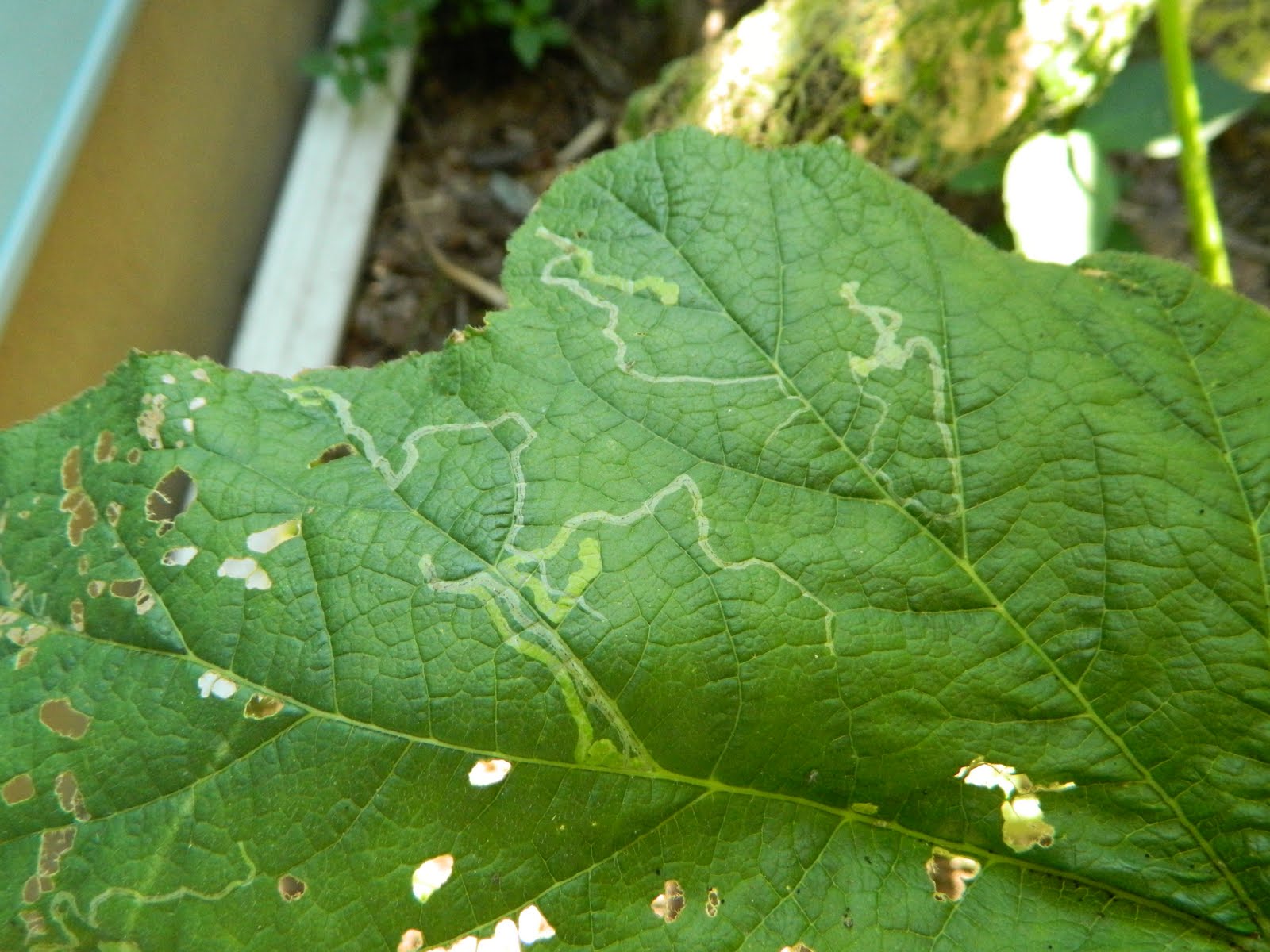
White insect husks
This hollyhock is home to an entire ecosystem. I kept examining the leaves and finding more insects. Another potential concern were several white insect exoskeletons perched around the plant. They are no longer alive, but since there were so many of them (about 5) it caused me to wonder whether they had turned into something else.
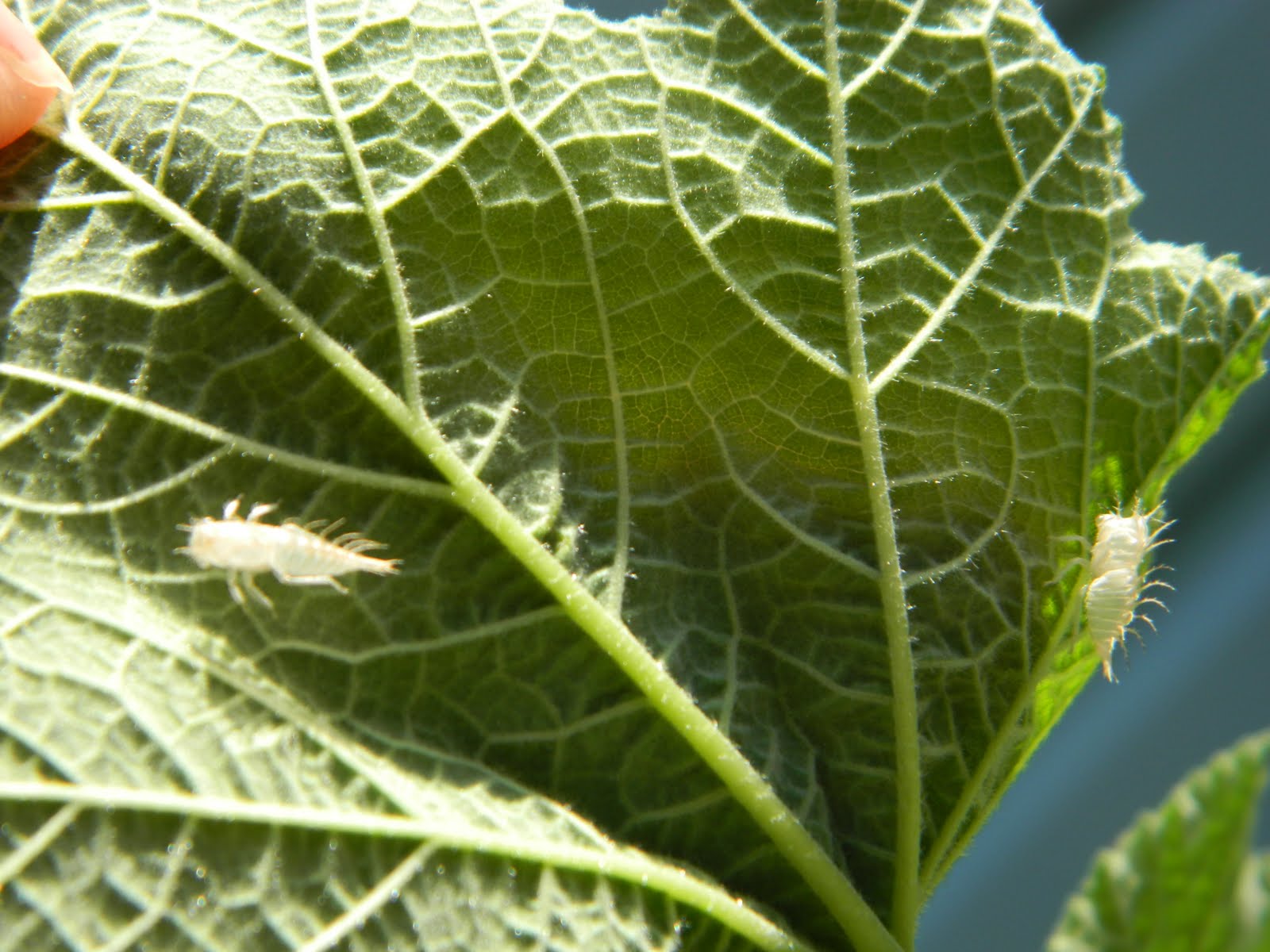

I am not as concerned about these given that they are dead and therefore incapable of doing additional damage to the plant. However, I've never seen them before and would like to know what they are. Did they give birth to the caterpillars?? Are they related to any of the other creatures who call this hollyhock home?
Love,
Rachel
Answer
Rachel and Mom,
I was all set to write a post on the wonders of Bt, because it is the best organic control for caterpillars. BUT. Looking at the pictures, it seems the first two culprits are the same thing: Sawflies. I think it's the Black-Headed Ash Sawfly, if we want to get specific. So Bt wouldn't work, because these guys only look like caterpillars. Rachel, you won't encounter this species in Seattle. They range from the east coast to the great plains. You might encounter another type of sawfly, though. Sawflies are in the Order Hymenoptera, which is generally a helpful order including bees and parasitic wasps. But these guys are pests. The grubs skeletonize leaves, like you see here, eating everything but the leaf stems. Some people call this windowing, but that technically applies to a different type of damage. Other species of sawflies can mine or window instead. The Black Headed Ash Sawfly really likes ornamental plants and shrubs. They're gregarious, meaning they often line up 5-6 in a row while feeding.
Here's a picture:
 They have black heads in the larval stage, which are visible in your pictures. Most of them I've seen have whitish, clearish bodies - like those to the left. I think yours are green because of how much hollyhock they've ingested. But the black heads are clearly visible, and the damage fits. You also caught the adults both mating and ovipositing on the leaves.
Here's an adult:

Established plants can handle a surprisingly large amount of sawfly damage. These are attacking the lower leaves and leaving the upper foliage intact, but the damage is a little worrying. They have a lot of natural enemies, which usually provide sufficient control. For whatever reason, there don't seem to be many natural enemies preying on these guys. You should probably order some lacewings to release, and they'd be good for your entire yard/garden anyway.
http://www.gardensalive.com/product.asp?pn=5030
Yellow flowers in the area might attract some parasitic wasps and syrphid flies. The adults feed on the nectar and oviposit nearby if they detect prey. It's not a guarantee, but it doesn't hurt either. Meanwhile, picking the sawflies off and squishing them is a good idea. If that's too icky, you could simply remove the damaged leaves with larvae on them. Don't use any broad spectrum pesticides, because that also kills the natural enemies. The sawfly population will likely bounce back well before the natural enemy population. So pesticides can actually make the problem worse. If you know you're going to lose a given leaf, you could apply an oil. Don't do this on the whole plant though, because that will clog the plant's stomata (or breathing tubes) and kill it. But if a given leaf is already pretty much gone, oil is an alternative to picking them off. It could also trap some of the adults who land on the plant. You might even try knocking them off with water from the hose. Don't know if it'll work without damaging the flowers, but it's worth a shot.
Tunneling
That's some kind of leafminer, but I can't identify it without seeing an adult. It's probably some type of fly, but there are lepidopteran (moth) and hymenopteran (other species of sawfly, etc) miners too. It doesn't matter, though. Leafminers rarely cause damage. Well, they cause cosmetic damage, so commercial outfits hate them, but they rarely hurt a plant. I wouldn't worry about it unless they start killing leaves. I highly doubt that will happen. I kind of think the mines are pretty, but I'm weird that way. Just FYI, spray pesticides rarely work on leafminers. As you noticed, they're inside the leaves. There are systemic pesticides (that were supposed to be safe) but we're finding out they destroy bee populations. (Well, the data has become so convincing that even the pesticide companies are starting to acknowledge it). So it isn't good to use them on anything that blooms. If you really want to get rid of leafminers, best to dig them out. Treat the mine like a maze and follow it to both ends. One is the beginning and the other is the end of the path. They only go forwards. If you find a largish hole in one end, then you're too late. The sucker has already escaped. If not, scoop out both ends and you'll likely get the larva.
White Insect Husks
Close guess, they are what the larvae turn into. I think these might even be the sawfly pupae (or cocoons). But I've never seen a pupa of this species. If so, you captured the entire generation of sawflies in pictorial form! The adults do their "dirty deeds" (as you put it), and the female deposits the eggs on the leaf. The egg hatches and the sawfly larva eats and eats and eats. Then it pupates - or builds a cocoon and stops doing outside activities to focus on changing it's entire body style. When it's done with that, the adults emerge to use the hollyhock as a singles bar again. These are the casings left behind after the pupa emerge to adults. Mom, if you see any of these that aren't empty, kill them too. They're kind of cool to pick up and see if they'll wiggle for you. But they don't have mouths or the ability to poop on you either. That way you'll have fewer adult pests in the area. Incidentally, did you notice all the little black dots on the leaves? That's frass, or bug poop.
Love,
Aim
Addendum: Syrphid Larvae are natural enemies
In answering Laurence's question about sawflies in Alaska, I talk about syrphid fly larvae - an important natural enemy. I haven't seen these predators covered as much for home gardeners, and they could be confused with sawfly larvae if you aren't looking for them. They are voracious hunters, and will help control aphid populations as well. The adults will pollinate your flowers and the immatures will help control all manner of pests. So I've added some pictures.
Here's a picture of the generations of syrphid flies

Here's a picture of a larvae, chomping on an aphid

And here's another picture of a syrphid fly larva.

If you see these on any plant, leave them. They're pretty awesome.


