Pages

Showing posts with label leaf miners. Show all posts

Sunday, June 19, 2011

Small green caterpillars, black flies with red heads, tunnel damage - Answered

Aim:

I've returned from Joplin. Lots to tell about the tornado and the destruction it left behind. I will save that for another day. While I was there, Mom asked me to take a look at her hollyhock in the back yard, which has some problems. For one thing, its lower leaves are all eaten out.

I found the culprit fairly quickly - caterpillars. They are very small and well camouflaged, so Mom had missed seeing them without her glasses. Here are some pictures. It's sort of like Where's Waldo. We counted at least 7 in this photo:


Here is another picture of one caterpillar actually chomping on a leaf:


We picked all of them off and squished them by hand. Well, I squished them and Mom said "eeeew." I find it oddly satisfying to squish them, but I'm pretty sure Mom would prefer a remedy that does not involve green goo on her fingers. Perhaps beneficial predators? I was wondering if lacewings would do the trick.

Black Flies
The caterpillars are not alone. In addition, there were at least 6 or 7 of these black winged bugs hanging out on the plant as well:


The hollyhock may serve merely as a singles bar for these bugs, though, as they appeared to be doing some dirty deeds with each other:

We don't know whether they are eating foliage, or eating the bad guys, or merely mating (or farting on each other, because frankly that's what it looks like). Thoughts?

Tunneling
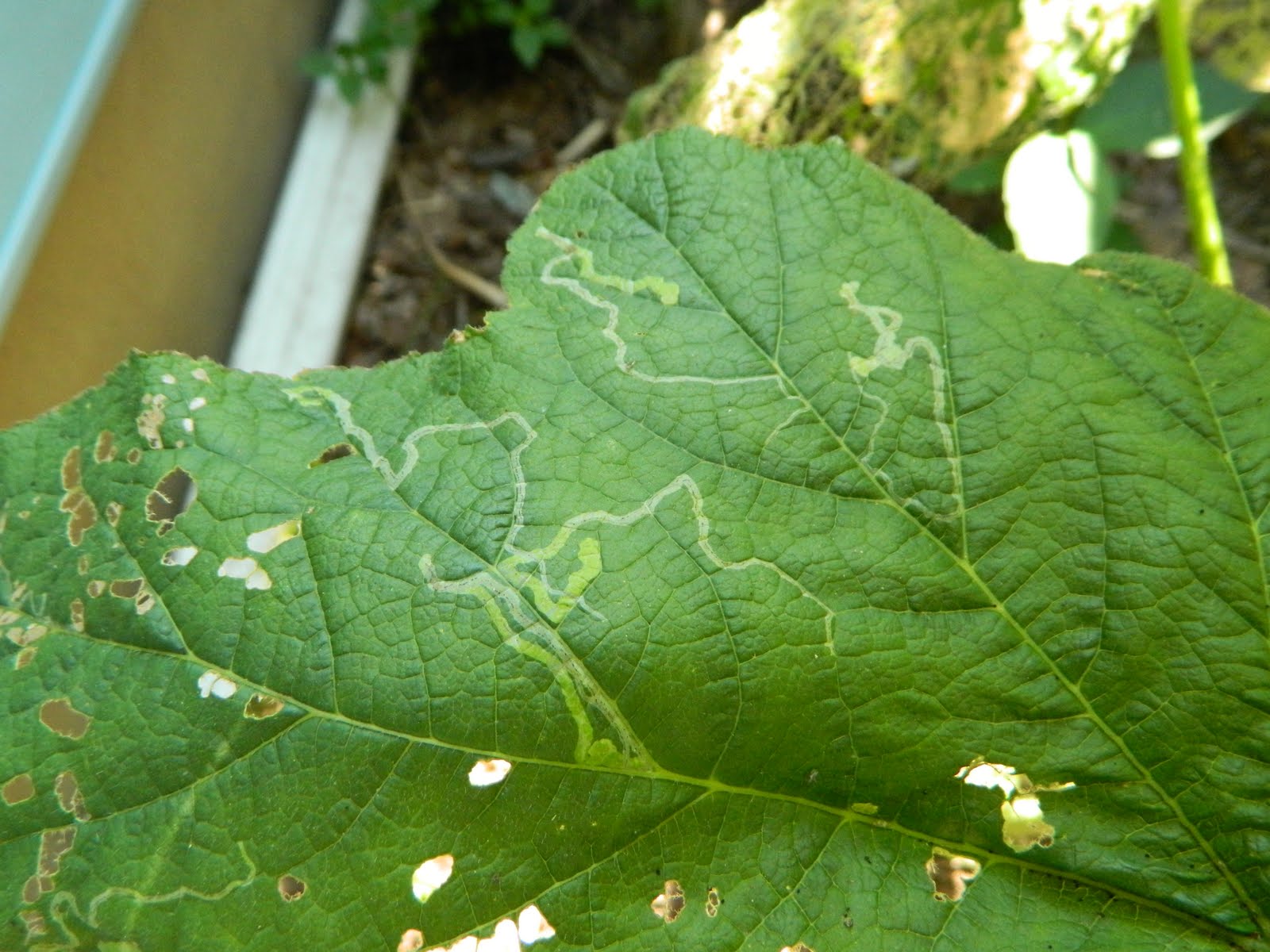
Aside from the caterpillar damage, there are also several discolored tunnels on the foliage with no visible culprit. It looks like trails left behind from a wiggling creature, but the discoloration almost seems to be embedded in the leaf rather than on top of it. The trails are not stains on top that you can wipe off. If you lift the leaf up to the sun, more light comes through the discolored tunnels than through the undamaged leaf part. I've never seen this before. What do you think?

White insect husks
This hollyhock is home to an entire ecosystem. I kept examining the leaves and finding more insects. Another potential concern were several white insect exoskeletons perched around the plant. They are no longer alive, but since there were so many of them (about 5) it caused me to wonder whether they had turned into something else.
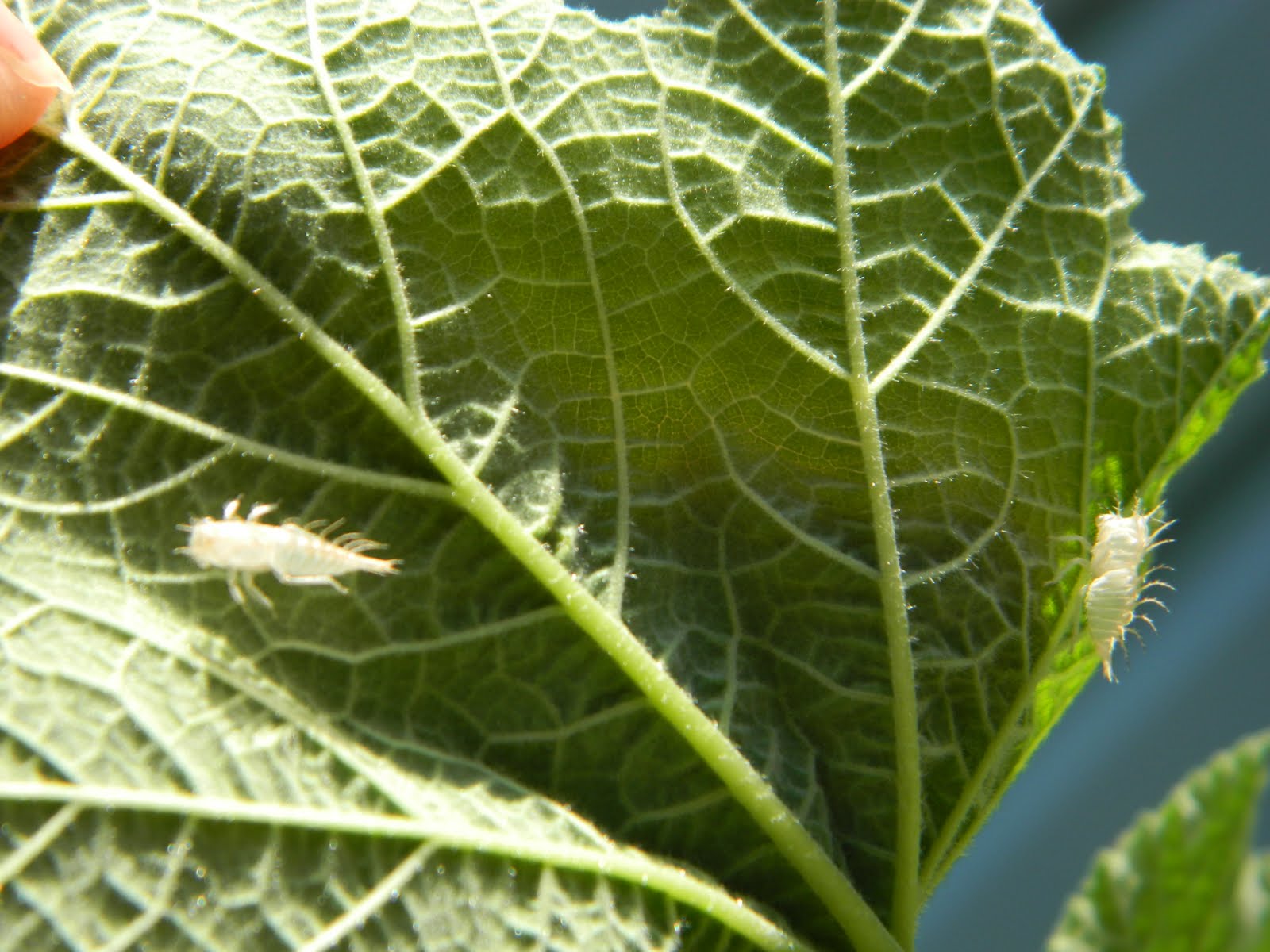

I am not as concerned about these given that they are dead and therefore incapable of doing additional damage to the plant. However, I've never seen them before and would like to know what they are. Did they give birth to the caterpillars?? Are they related to any of the other creatures who call this hollyhock home?

Love,
Rachel

Answer

Rachel and Mom,

I was all set to write a post on the wonders of Bt, because it is the best organic control for caterpillars. BUT. Looking at the pictures, it seems the first two culprits are the same thing: Sawflies. I think it's the Black-Headed Ash Sawfly, if we want to get specific. So Bt wouldn't work, because these guys only look like caterpillars. Rachel, you won't encounter this species in Seattle. They range from the east coast to the great plains. You might encounter another type of sawfly, though. Sawflies are in the Order Hymenoptera, which is generally a helpful order including bees and parasitic wasps. But these guys are pests. The grubs skeletonize leaves, like you see here, eating everything but the leaf stems. Some people call this windowing, but that technically applies to a different type of damage. Other species of sawflies can mine or window instead. The Black Headed Ash Sawfly really likes ornamental plants and shrubs. They're gregarious, meaning they often line up 5-6 in a row while feeding.

Here's a picture:
They have black heads in the larval stage, which are visible in your pictures. Most of them I've seen have whitish, clearish bodies - like those to the left. I think yours are green because of how much hollyhock they've ingested. But the black heads are clearly visible, and the damage fits. You also caught the adults both mating and ovipositing on the leaves.

Here's an adult:


Established plants can handle a surprisingly large amount of sawfly damage. These are attacking the lower leaves and leaving the upper foliage intact, but the damage is a little worrying. They have a lot of natural enemies, which usually provide sufficient control. For whatever reason, there don't seem to be many natural enemies preying on these guys. You should probably order some lacewings to release, and they'd be good for your entire yard/garden anyway.
http://www.gardensalive.com/product.asp?pn=5030

Yellow flowers in the area might attract some parasitic wasps and syrphid flies. The adults feed on the nectar and oviposit nearby if they detect prey. It's not a guarantee, but it doesn't hurt either. Meanwhile, picking the sawflies off and squishing them is a good idea. If that's too icky, you could simply remove the damaged leaves with larvae on them. Don't use any broad spectrum pesticides, because that also kills the natural enemies. The sawfly population will likely bounce back well before the natural enemy population. So pesticides can actually make the problem worse. If you know you're going to lose a given leaf, you could apply an oil. Don't do this on the whole plant though, because that will clog the plant's stomata (or breathing tubes) and kill it. But if a given leaf is already pretty much gone, oil is an alternative to picking them off. It could also trap some of the adults who land on the plant. You might even try knocking them off with water from the hose. Don't know if it'll work without damaging the flowers, but it's worth a shot.

Tunneling
That's some kind of leafminer, but I can't identify it without seeing an adult. It's probably some type of fly, but there are lepidopteran (moth) and hymenopteran (other species of sawfly, etc) miners too. It doesn't matter, though. Leafminers rarely cause damage. Well, they cause cosmetic damage, so commercial outfits hate them, but they rarely hurt a plant. I wouldn't worry about it unless they start killing leaves. I highly doubt that will happen. I kind of think the mines are pretty, but I'm weird that way. Just FYI, spray pesticides rarely work on leafminers. As you noticed, they're inside the leaves. There are systemic pesticides (that were supposed to be safe) but we're finding out they destroy bee populations. (Well, the data has become so convincing that even the pesticide companies are starting to acknowledge it). So it isn't good to use them on anything that blooms. If you really want to get rid of leafminers, best to dig them out. Treat the mine like a maze and follow it to both ends. One is the beginning and the other is the end of the path. They only go forwards. If you find a largish hole in one end, then you're too late. The sucker has already escaped. If not, scoop out both ends and you'll likely get the larva.

White Insect Husks
Close guess, they are what the larvae turn into. I think these might even be the sawfly pupae (or cocoons). But I've never seen a pupa of this species. If so, you captured the entire generation of sawflies in pictorial form! The adults do their "dirty deeds" (as you put it), and the female deposits the eggs on the leaf. The egg hatches and the sawfly larva eats and eats and eats. Then it pupates - or builds a cocoon and stops doing outside activities to focus on changing it's entire body style. When it's done with that, the adults emerge to use the hollyhock as a singles bar again. These are the casings left behind after the pupa emerge to adults. Mom, if you see any of these that aren't empty, kill them too. They're kind of cool to pick up and see if they'll wiggle for you. But they don't have mouths or the ability to poop on you either. That way you'll have fewer adult pests in the area. Incidentally, did you notice all the little black dots on the leaves? That's frass, or bug poop.

Love,
Aim

Addendum: Syrphid Larvae are natural enemies
In answering Laurence's question about sawflies in Alaska, I talk about syrphid fly larvae - an important natural enemy. I haven't seen these predators covered as much for home gardeners, and they could be confused with sawfly larvae if you aren't looking for them. They are voracious hunters, and will help control aphid populations as well. The adults will pollinate your flowers and the immatures will help control all manner of pests. So I've added some pictures.

Here's a picture of the generations of syrphid flies


Here's a picture of a larvae, chomping on an aphid


And here's another picture of a syrphid fly larva.

If you see these on any plant, leave them. They're pretty awesome.

Monday, July 12, 2010

Black Bug on Tomato Plant

Amy:

I have never had a problem with pests on my tomatoes until this spring. Some of the tomato leaves have bites taken out of them. Luckily, the recent hot weather and sun have given my tomatoes enough vigor to ward off the effects, but I took a couple of pictures a few weeks ago when I was concerned about them. You can see it in the first picture, below.

I noticed a little black bug on some of the leaves. I used the macro setting on the camera to take a close-up of it. Thoughts?

Like I said, the good news is that most of my tomato plants are tolerating whatever pest it is. It's not killing them completely. But I'd like to know what it is, because it's certainly taking out some of the leaves, which are very important for sugar production to fuel the tomato fruits that will arrive soon.


----------------------------------------

Rachel:


I... really don't know what the black bug is. My first thought is that it's some sort of robberfly, which would be good. However, the wing placement is wrong. And it might be a leaf miner you caught while ovipositing. A taxonomist would be able to look at it and say, "Oh, that's a grylloblattid." (Actually, a taxonomist would never say that because grylloblattids live under glaciers, but you get my drift.) Keep an eye on the plant, and let me know if you find any more. If you do, try to get another picture. I should warn you, though, that I'm better at identifying larval stages that are more likely to be eating the plant. Most of the adult pests of tomato (ie insects that eat the leaves when they are fully grown) are beetles. If this is a pest, it's probably a female depositing her youngsters.

I'm more concerned with the tiny green things I can see below that gal. I can't tell what they are from the picture. If you could go out with a magnifying glass or loop and describe them, that would help. They could be psyllids, which are only a few millimeters long, but you said the tomatoes are doing well. Psyllids have toxic saliva, which causes the leaves to turn yellow. They probably aren't causing the holes. So, even if you have a few psyllids, the plant is overcoming them. They could also be little baby leaf miners that the mom just popped out. I really don't know.

Whatever it is, it can cause the plant to produce less fruit.

Let's talk damage: you've got a moth leaf miner, but it doesn't seem too bad from the picture. You've got something taking out large holes. Normally, I'd assume this is some kind of worm (caterpillar), probably a cabbage looper and maybe a hornworm. Cabbage loopers (see left) are small, green and cute. They hang out on the underside of leaves, and chew everything but the leaf stems. Hornworms are big, with a horn sticking out of their butts (see left below). 1 lonely hornworm can do a lot of damage to a given plant, but Home gardens don't usually have more than one or two. These caterpillar eggs are laid singly, and the insects have a relatively large generation interval. If you don't have a heavy infestation, just pick any caterpillars off when you find them. I'd hate to waste any Bt on a plant that's doing okay, because it may be something else. But check the plant. Hornworms will eat your baby tomatoes too. Make sure you check the plant when there is plenty of daylight, but the sun isn't directly shining on it. Early evening and late morning are good times to look.


There are a number of beetles that feed on tomato leaves. The small things I can't see could be flea beetles. They leave smallish holes in leaves, some of them expanding to create bigger holes. You'll see them hanging out all over if it isn't too hot out. Let me know if you find any beetles on the plant. If you find one that looks like the picture on the right, don't touch it. It might have color on it, but the body style will be similar. That's a blister beetle. They cause, wait for it... blisters! I don't think you have any of them. If you find some, let me know. We'll talk pest management then.

Finally, there are leaf miners that can cause holes to appear in a plant as well. I see some "windowing" damage, where all of the leaf is removed save for a thin layer. Sometimes these thin layers get knocked out (by watering, wind, etc) and turn it into a full-fledged hole.

Do me a favor and look closely at the holes. Does it look like they were formed by something taking small bites, and turning it into a big hole? Are the edges pretty rounded?

Look for caterpillars around your tomato plants; look for any kind of beetle as well. If you can find any of the things I circled in the first picture, try to get a better look at them. Also, if you can get another picture of the black fly-type insect. If the damage has changed at all, I'd like to see another big picture of the plant.

Also, I realize this is a little late. So if your tomatoes are doing fine, then just ignore!

----------------------------------------
Aim,

You are a major dork. What is oviposting?? It sounds like a scientific euphemism for bug sex.

Speaking of which, the black bugs are multiplying. I examined another tomato plant this evening and found a community of the black bugs. I took some more pictures (see below). Damage-wise, the only thing I can find is some mysterious curling of the leaves. At first I though the curling had to do with lack of water, but no. So, I can't tell if the black bugs are good-guys eating something bad that I cannot see, or whether they are chomping on my tomato leaves, or whether they are just chilling and keeping it real.

But it's a little unnerving to see the congregation of them on my tomato. I'm obsessed with my tomatoes. It's hard not to be obsessed with tomatoes in the pacific northwest, where tomatoes arguably are not supposed to grow, because it is so far away from their native climate. I start them from seed in the late winter and nurture them all the way through the clouds and rain of spring.  I get very invested in seeing them eventually produce fruit.

Anyhow, here are the mystery bugs.


--------------------------------------

Rach,

Ovipositing is totally all about sex. Sorta. The sex has already taken place. It refers to when the female deposits a fertilized egg. And it covers all kinds of activities. A leaf miner, for instance, has a structure which slices into the leaf but not all the way through. Therefore, when the egg hatches, the larva is protected inside the leaf. Honeybees have converted their ovipositors to stingers. So a male bee can't sting you, because they don't have the sexual organs to create a stinger. Dragon and damselflies have long ovipositors because they place eggs on vegetation just below the surface of the water. You'll see the male riding piggyback on the female, until she dips her abdomen into the water. He's making sure that another male doesn't eject his sperm and replace it with his own. Some males get around this by pretending to be females. So the other guys don't know that she mated. We call these "sneaky males." Highly scientific term, there. Also, if the female has mated twice, she can manipulate which sperm she prefers while it's all mixing around in her spermatheca (doesn't that sound dirty). Insects have some pretty freaky sex. That's actually pretty tame. Don't get me started on spit balls.... Anyway. uh. So that's ovipositing.

I'm a little confused because I don't see any damage on the leaves. Is there any substantial damage? This morning I was thinking it might be leaf miners. But I don't see any mining going on in these pictures. I'm actually leaning towards psyllids again. They certainly look like psyllids from here. Also, the immatures are so small, they can be hard to see. They cause the most damage in young plants and transplants. They also cause curling of the leaves. Here's a picture of an adult psyllid.

I think I mentioned this earlier, but psyllids introduce a toxin that causes leaves to turn yellow. We don't know think the adults do this. It's possible that you had a pretty large population of immature psyllids bothering the plant, but that the adults are now hatching. They're still feeding, but they don't have toxic saliva. That might explain why the plant doesn't seem as stressed. Of course, these psyllids will reproduce. You might go through another cycle where the immatures damage the plant. It might be strong enough to overcome them at this point. I'd say just keep an eye on it. Maybe wipe off the plant and try to kill as many as you can. If the plant starts looking bad again, there are organic pesticide which seem to work okay. There are natural enemies of psyllids, like the lacewings you're releasing, but they don't seem to eat the psyllids during the time they're dangerous. So, organic pesticides work in a pinch. Specifically the Ensure version of Spinosad. This is a nicotine-based pesticide that's made from fermenting the microorganism Actinomycetes spinosa. It targets the nerve synapses by binding to the nicotine receptor site. (There are some nicotine-based pesticides that are NOT organic, just FYI). It doesn't harm natural enemies. It comes as a spray, so you don't have to worry about eating it. Just clean off the tomatoes, if you spray when you have any.

Oooo also. If you know you have psyllids in the garden, DON"T use any carbamate pesticides on any other plants. Sevin is a common name. They actually promote psyllid populations.